Learning Tips#
Study Tips#
- Study consistently: Daily practice is more effective than long, infrequent sessions
- Speak out loud: For pronunciation cards, always speak the answer aloud
- Use the audio: Listen carefully to native pronunciation on all audio-enabled cards
- Don’t rush: Take time to recall the answer before revealing it
- Be honest: Mark cards as “Again” if you couldn’t recall the answer quickly
Adjusting Deck Options#
Avoid learning too many new cards per day because it might quickly become overwhelming. The default value of New cards/day of 20 is a good start.
We strongly encourage you activate burying to make your learning most efficient. Otherwise you may for example be asked to do Reading for a word that you just completed Pronunciation for, which makes it too easy. This would hurt your long term progress since a few weeks later you no longer have the Pronunciation context and will fail. Also in real-life situations when you need to read a word you lack that context.
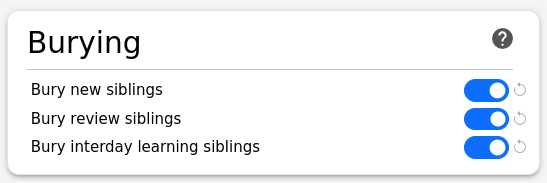
Enabling FSRS (Free Spaced Repetition Scheduler) is also a good idea because it calculates more optimal review intervals.
Consider not imposing any particular order on the cards since you are trying to learn for the real world where you also need to remember words in isolation. Set New card gather order to “Deck, then random notes” and New card sort order to “Random”.
See Anki’s documentation for detailed settings guidance.
Card Types#
Most AnkiLangs decks use four complementary card types to help you master vocabulary:
Pronunciation#
See the source language word and speak the target language word aloud. Focus on accurate pronunciation.
Listening#
Hear the target language word and recall its meaning in the source language. Trains your listening comprehension.
Reading#
See the target language word and recall its meaning in the source language. Trains your reading comprehension.
Spelling#
See the source language word, hear the target language pronunciation, and type the target language word. Reinforces spelling and combines reading with listening.
Minimal Pairs Decks#
For minimal pairs decks specifically:
- Listen carefully: Focus on the subtle differences between the sounds
- Repeat out loud: After revealing the answer, practice speaking both words
- Use the audio repeatedly: Play each audio multiple times if needed
- Practice regularly: Daily short sessions are more effective than long, infrequent ones